GEOTECHNICAL ENGINEERING1
SWINDON
HomeGround improvementVibrocompaction design

Vibrocompaction Design in Swindon: Densifying Ground for Stable Construction

Practical geotechnics, field-tested.

LEARN MORE

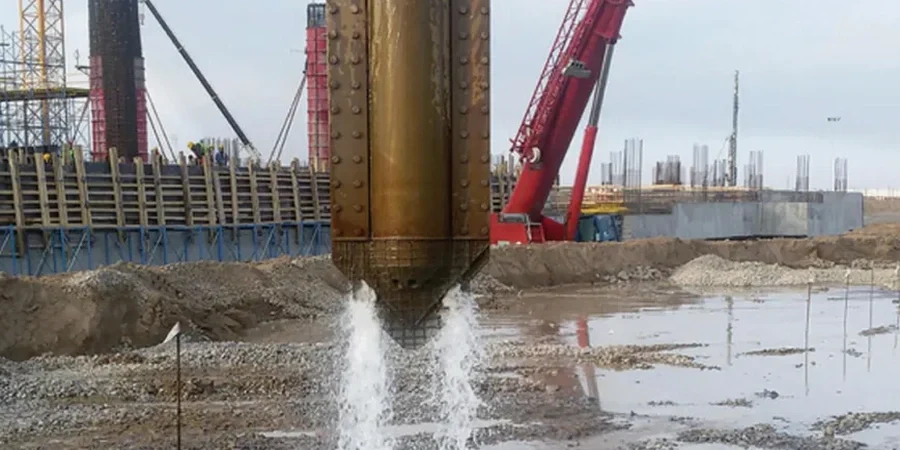
With over 233,000 residents and a growing commercial corridor along the M4, Swindon sits on a varied geological foundation that includes Kimmeridge Clay and pockets of alluvial and river terrace deposits. Ground improvement is not optional here—it is a precondition for long-term structural performance. Our vibrocompaction design service addresses loose granular soils found at shallow depths across the Swindon area, tailoring grid spacing and probe penetration to the specific grading of each site. The method relies on depth vibrators to rearrange particles into a denser state, increasing relative density and friction angle without importing fill material. For sites where the target stratum falls below the water table or contains interbedded silts, we integrate CPT testing to refine the compaction plan and verify homogeneity before foundation load transfer.

A properly designed vibrocompaction grid turns loose granular fill into an engineered bearing stratum without a single cubic metre of imported aggregate.
Our service areas

Process and scope

A detail we often observe across Swindon's development zones is the presence of made ground overlying natural gravels—legacy fill from the railway era that masks competent bearing layers. Effective vibrocompaction design here must account for this artificial crust, which can absorb energy and reduce compaction efficiency at depth. We define operational parameters based on probe type, vibration frequency, and withdrawal rate, using real-time compaction control systems that record amperage and penetration resistance. The design package includes a compaction point grid, target depth per point, and pre- and post-treatment verification testing. Key elements we address: settlement reduction factors under service loads; improvement of cyclic resistance for dynamic equipment foundations; lateral stress increase for shallow footings; and drainage path shortening in silty sands. The approach follows BS EN 1997-1:2004 for ultimate and serviceability limit state verification, ensuring the improved ground mass meets the design assumptions of the structural engineer.
Vibrocompaction Design in Swindon: Densifying Ground for Stable Construction
Technical reference — Swindon

Local considerations

Swindon's river terrace gravels, while generally competent, can exhibit localised loosening where paleochannels have been infilled with soft silts and organic clays. An incomplete ground investigation that misses these buried features leads to differential settlement—a risk we have seen manifest in industrial units near the Dorcan area when compaction was omitted based on surface observations alone. The other failure mode is excessive fines content: if the silt-plus-clay fraction exceeds 15%, vibrocompaction alone cannot achieve the required densification, and the design must pivot to stone columns or mixed-in-place techniques. Our role is to confirm treatability through a detailed grain size analysis and trial compaction field test before committing to full-scale treatment, preventing costly redesigns during the construction phase.

Need a geotechnical assessment?

Reply within 24h.

Email: contact@geotechnical-engineering1.com

Reference standards

BS EN 1997-1:2004 (Eurocode 7: Geotechnical design – General rules), BS 5930:2015 (Code of practice for ground investigations), BS 1377 (Methods of test for soils for civil engineering purposes), BRE Special Digest 1 (Concrete in aggressive ground), ICE Specification for Ground Treatment

Reference parameters

ParameterTypical value
Applicable soil typesGranular soils with fines content < 12%, D10 > 0.05 mm
Typical depth range4 m to 30 m below working platform
Probe types consideredV23, V32, V48; electric or hydraulic drive
Grid geometryTriangular or square pattern, 1.8 m to 3.5 m spacing
Post-treatment verificationCPT, SPT, PMT, or zone load test per BS 1377
Relative density targetDr > 65% (up to 85% for seismic zones)
Vibration frequency range30 Hz to 50 Hz, adjusted for grain size curve

Questions and answers

What does vibrocompaction design cost for a typical Swindon industrial plot?

For a standard industrial unit footprint in Swindon (roughly 1,500 to 3,000 square metres), the design package—including desk study, treatability assessment, trial compaction, and production design—generally falls between £1,020 and £3,670. The final figure depends on grid density, depth of treatment, and the number of verification tests required by the project specification.

How do you verify that compaction has worked at depth?

We specify pre- and post-treatment CPT or SPT soundings at grid centroid locations. The acceptance criterion is typically a target cone resistance or N-value profile derived during the trial compaction. In critical zones, we may add pressuremeter tests to directly measure the increase in deformation modulus.

Can vibrocompaction be used near existing structures in Swindon's town centre?

It can, but with precautions. Vibratory energy attenuates with distance, and we model peak particle velocity against BS 5228-2 thresholds to define exclusion zones. Within 5 metres of sensitive buildings or buried services, we typically switch to a lower-energy probe or specify real-time vibration monitoring to stay within safe limits.

Location and service area

We serve projects in Swindon and surrounding areas.

View larger map