GEOTECHNICAL ENGINEERING1
SWINDON
HomeGround improvementStone column design

Stone Column Design for Ground Improvement in Swindon

Practical geotechnics, field-tested.

LEARN MORE

Too many foundation designs in Swindon still treat the ground as if it were a uniform, competent bearing stratum. The reality across much of the town is a sequence of Kimmeridge Clay overlain by variable made ground, particularly on the former railway lands and post-war industrial estates. When a standard pad or raft comes back with excessive differential settlement, the knee-jerk reaction is often an expensive deep pile grid. A properly engineered stone column design can cut project costs significantly—sometimes by a third or more—while delivering the same settlement performance. The key is understanding when vibro-replacement works and when it doesn't, and that judgement comes from interpreting the right ground investigation data. In the Swindon area, where soft alluvium lenses sit within the clay profile, we typically combine findings from CPT testing with laboratory classification to define the undrained shear strength envelope before committing to column spacing and diameter.

In Swindon's Kimmeridge Clay, a well-designed stone column grid can reduce total settlement by half compared to untreated ground, often making shallow foundations viable on sites that would otherwise demand piling.
Our service areas

Process and scope

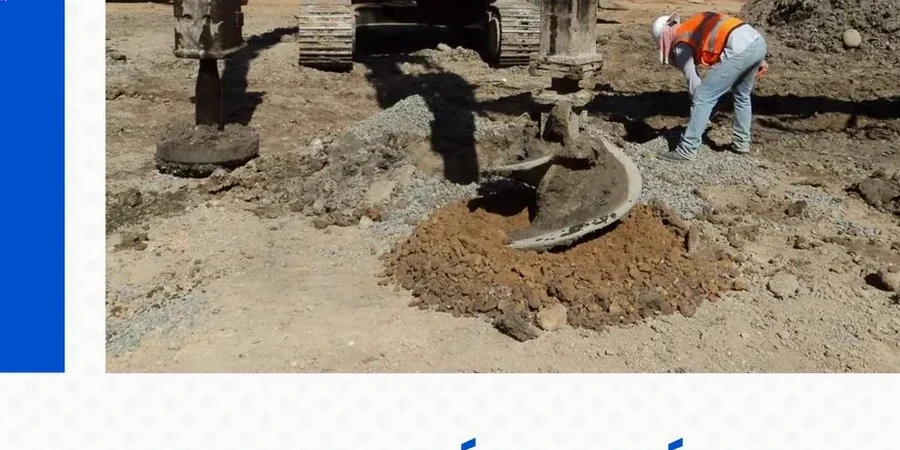
The Upper Jurassic Kimmeridge Clay beneath Swindon presents a particular challenge: its undrained shear strength can drop below 30 kPa in the weathered zone, yet it often sits just a few metres above much stiffer material. This stratigraphy makes it an ideal candidate for stone columns, provided the designer respects the bulging failure mode that governs soft clays. A stone column design for Swindon conditions typically targets a replacement ratio between 15 and 25 percent, using 600 to 900 mm diameter columns installed by bottom-feed vibroflot to depths of 6 to 10 metres. The granular fill must comply with BS EN 13242, with a friction angle exceeding 40 degrees after compaction—we specify crushed angular aggregate rather than rounded gravel for better interlock. For sites where the clay is particularly sensitive, we integrate the column layout with a load transfer platform that uses geogrid reinforcement, and we often cross-check the settlement predictions using the Priebe method against a finite element model calibrated with parameters from a triaxial test programme. On brownfield plots within the former GWR works footprint, the presence of buried obstructions means the design has to include contingency for re-spacing columns around unexpected debris, something you learn only by doing this work in Swindon year after year.
Stone Column Design for Ground Improvement in Swindon
Technical reference — Swindon

Local considerations

BS EN 1997-1 requires that ground improvement designs be validated by field testing—not just assumed from desk studies. In Swindon, the risk of skipping post-installation verification is particularly acute because the made ground thickness varies unpredictably, sometimes concealing old basements or backfilled pits that create soft spots between columns. The accepted verification method under EC7 is the zone load test, typically on a group of three to five columns, loaded to at least 1.5 times the working load. Without this, the design remains unconfirmed and the superstructure warranty may be compromised. A secondary risk in the Swindon area is fines migration into the column from surrounding silty clay if the filter criteria are not checked—this can lead to gradual clogging and loss of drainage function, which is half the benefit of the system. The British Geotechnical Association's good practice guidance (based on the ICE specification) explicitly warns against omitting the filter compatibility check, and on Swindon sites with high groundwater we always run a grain size analysis on the native soil before finalising the aggregate gradation.

Need a geotechnical assessment?

Reply within 24h.

Email: contact@geotechnical-engineering1.com

Reference standards

BS EN 1997-1:2004 (Eurocode 7, Geotechnical design), BS EN 13242 (Aggregates for unbound and hydraulically bound materials), BS 5930:2015 (Code of practice for ground investigations), ICE Specification for Ground Treatment (current edition)

Reference parameters

ParameterTypical value
Typical column diameter600–900 mm
Replacement ratio range15–25%
Design depth in Swindon clay6–10 m
Required aggregate friction angle≥ 40° (crushed angular)
Applicable failure mode (soft clay)Bulging in upper 3–4D
Load transfer platform thickness0.3–0.6 m (reinforced)
Design standardBS EN 1997-1 (EC7, DA1)

Questions and answers

What ground conditions in Swindon make stone columns the right choice?

Stone columns work best in soft cohesive soils with undrained shear strength between 15 and 50 kPa, which describes much of the weathered Kimmeridge Clay and alluvial pockets found across Swindon. They are also effective in loose silty sands and made ground where the fines content is below about 20 percent. The technique is less suitable in very soft clays below 15 kPa—where columns may not form properly—or in ground with a high water table and artesian conditions unless a bottom-feed vibrator is specified. Each Swindon site needs its own assessment, but the local geology frequently falls within the ideal range.

How much does stone column design cost for a project in Swindon?

For a typical Swindon commercial or residential development, the design package—including feasibility review, detailed design calculations, and a verification specification—falls in the range of £1,250 to £4,500. The final figure depends on the site area, the number of columns, whether finite element modelling is required, and the complexity of the load transfer platform. This is the design cost only; installation is procured separately through ground treatment contractors.

How is the stone column design verified after installation?

Verification follows the ICE Specification for Ground Treatment and BS EN 1997-1 requirements. The primary method is a zone load test, where a group of columns (usually three to five) is loaded through a stiff platform to at least 150 percent of the design working load. Settlement is measured over a sustained holding period and compared against the design predictions. We also specify that a minimum of one column per 50 installed be exhumed to at least 1.5 metres depth to visually check column continuity, diameter, and aggregate compaction.

Can stone columns be used beneath heavily loaded structures like warehouse racking?

Yes, and this is a common application on Swindon's distribution centre sites around the A419 corridor. The design must account for the concentrated nature of racking leg loads, which can exceed 300 kN per leg. We typically densify the column grid beneath heavily loaded aisles and may increase the replacement ratio locally. A load transfer platform with one or two layers of geogrid is almost always specified to bridge between columns and distribute the concentrated loads, preventing punching shear failure in the platform itself.

What is the difference between stone columns and vibrocompaction?

Stone columns replace weak soil with a compacted granular column that both reinforces and drains the ground, making them suitable for cohesive soils where drainage is needed. Vibrocompaction, by contrast, densifies granular soils in situ without adding material and works only in sands and gravels with low fines content. In Swindon, where the problem soils are predominantly cohesive clays and silts, stone columns are the appropriate choice; vibrocompaction would have negligible effect on the Kimmeridge Clay. We offer both techniques and select based on the grain size distribution from the site investigation, which you can explore further in our grain size analysis service.

Location and service area

We serve projects in Swindon and surrounding areas.

View larger map