GEOTECHNICAL ENGINEERING1
SWINDON
HomeLaboratoryTriaxial test

Triaxial Testing for Construction Projects in Swindon

Practical geotechnics, field-tested.

LEARN MORE

Swindon's rapid expansion eastward into greenfield sites has placed new demands on geotechnical investigation across the Upper Thames valley, where the transition from the limestone ridge of Old Town down to the Kimmeridge Clay lowlands creates abrupt changes in bearing capacity over very short distances. The weathered mudstones and clays that underlie much of the borough present a particular challenge for designers who need reliable effective stress parameters rather than relying on total stress assumptions that can inflate foundation costs unnecessarily. For projects on these complex glacial and Jurassic deposits, the triaxial test provides the most complete picture of a soil's mechanical behaviour under controlled drainage conditions, capturing the friction angle and cohesion values that Eurocode 7 requires for serviceability limit state assessments. When borehole logs indicate interbedded silts and clays around the M4 corridor developments, our laboratory team runs consolidated undrained triaxial with pore pressure measurement so that the engineering consultant can separate short-term construction stability from long-term settlement predictions. Complementing the triaxial programme with CPT testing on site gives a continuous profile of tip resistance that helps select the most representative depths for undisturbed sampling, reducing the risk of testing disturbed or remoulded specimens that would underrepresent the true shear strength of the formation.

Effective stress parameters from a properly drained triaxial programme often reduce foundation widths by 15 to 20 percent compared to conservative total stress assumptions on Swindon's clay sites.
Our service areas

Process and scope

A common mistake we see on brownfield redevelopments near the old railway works is specifying a single undrained shear strength envelope for the entire site when the upper 3 metres may be desiccated fill over normally consolidated clay with completely different pore pressure response. The triaxial test is the only laboratory procedure that can isolate the drained and undrained components of strength while monitoring volume change or excess pore pressure throughout the shearing stage, giving the designer a complete stress path that no direct shear box can replicate. Each specimen is saturated under back pressure, consolidated to the estimated in-situ stress state, and then sheared at a rate slow enough to allow pore pressure equalisation across the sample — a process that typically takes between five and ten days per three-specimen set. The result is a Mohr-Coulomb envelope defined by effective cohesion and effective friction angle, plus the stress-strain curves needed to calibrate the hardening soil model in finite element analyses. For the granular Corallian beds that appear at shallow depth below South Swindon, drained triaxial testing on reconstituted specimens provides the dilatancy parameters that control bearing capacity and shaft friction in deep foundations, directly feeding into the pile design calculations required by BS EN 1997-1:2004.
Triaxial Testing for Construction Projects in Swindon
Technical reference — Swindon

Local considerations

The Kimmeridge Clay that covers the northern and eastern expansion areas of Swindon is classified as a shrink-swell formation with a modified plasticity index frequently exceeding 30 percent, a value that places it firmly in the high-volume-change category under the NHBC Standards Chapter 4.2. When triaxial testing is omitted in favour of index testing alone, the designer cannot quantify the reduction in undrained shear strength that occurs as pore pressures equalise after construction, which is precisely the mechanism behind delayed slope failures and serviceability cracking in stiff clay cuttings. The drained friction angle for these materials typically ranges between 18 and 24 degrees — a narrow band that nonetheless produces widely different factors of safety when the slope geometry includes a surcharge from adjacent development. For structures within the influence zone of the Swindon Fault system that runs northwest-southeast across the borough, understanding the post-peak softening behaviour from a triaxial programme becomes critical, because progressive failure can initiate at strains well below the peak strength envelope, particularly in overconsolidated clays that exhibit brittle fracture rather than plastic yielding.

Need a geotechnical assessment?

Reply within 24h.

Email: contact@geotechnical-engineering1.com

Reference standards

BS 1377-8:1990 — Shear strength tests (effective stress), BS EN ISO 17892-9:2018 — Consolidated triaxial compression tests on water-saturated soils, Eurocode 7 (BS EN 1997-1:2004) — Geotechnical design: general rules, BS EN 1997-2:2007 — Ground investigation and testing, NHBC Standards Chapter 4.2 — Building near trees (shrinkable soils)

Reference parameters

ParameterTypical value
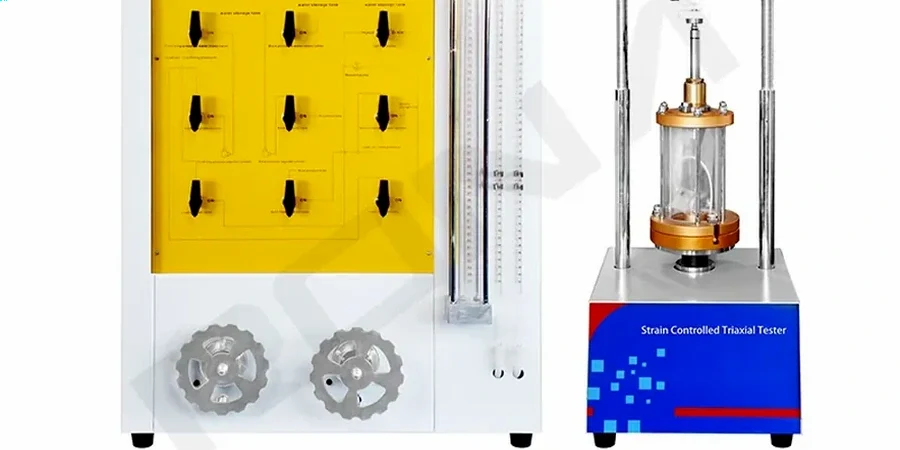
Test types availableUU, CU, CD, CIU with pore pressure measurement
Sample diameter38 mm, 50 mm, 70 mm, 100 mm
Maximum cell pressure1700 kPa (standard), 3500 kPa (high-pressure cell)
Shearing rate range0.001 mm/min to 5.0 mm/min, strain-controlled
Back pressure saturationSkempton B-value ≥ 0.95 verified before shearing stage
InstrumentationInternal load cell, submersible LVDT, pore pressure transducer
Reporting standardBS 1377-8:1990, BS EN ISO 17892-9:2018

Questions and answers

What is the typical cost of a triaxial test programme on a Swindon site?

A standard three-specimen consolidated undrained triaxial set with pore pressure measurement typically ranges from £1,310 to £1,990, depending on the sample diameter, the confining pressures required, and whether multi-stage testing is specified to reduce the number of specimens needed. The price includes saturation, consolidation, shearing, and a full interpretive report with Mohr-Coulomb parameters and stress-strain curves.

How long does triaxial testing take from sample delivery to final report?

A complete three-specimen consolidated undrained programme with pore pressure measurement generally requires seven to ten working days in the laboratory, though this can extend to two weeks if low-permeability Kimmeridge Clay specimens need extended consolidation stages to reach full pore pressure equalisation. We can prioritise urgent projects and deliver preliminary friction angle estimates within three to four days when the construction programme demands it.

Which triaxial test type is most appropriate for Swindon's clay soils?

For the stiff overconsolidated clays found across much of Swindon, we typically recommend consolidated undrained triaxial with pore pressure measurement, because it yields both the undrained shear strength for short-term stability checks and the effective stress parameters for long-term settlement and slope analysis from a single set of specimens. If the project involves embankment construction where full drainage can be assured during the design life, drained triaxial testing may be more appropriate.

What sample quality is required for a reliable triaxial test result?

The test is only as good as the sample it is performed on, and we require undisturbed samples taken with thin-walled Shelby tubes or pushed samplers in accordance with BS EN ISO 22475-1:2006, with a recovery ratio above 95 percent and no visible fissuring or desiccation. Samples should be sealed with wax immediately upon extrusion and transported in rigid core boxes to prevent vibration damage during transit to the laboratory.

Location and service area

We serve projects in Swindon and surrounding areas.

View larger map