GEOTECHNICAL ENGINEERING1
SWINDON
HomeUnderground ExcavationsGeotechnical excavation monitoring

Excavation Monitoring in Swindon: Safeguarding Deep Cuts on Variable Ground

Practical geotechnics, field-tested.

LEARN MORE

A common oversight on Swindon construction sites is treating the ground as a static entity. The reality is that the Upper Jurassic Kimmeridge Clay and patchy Coral Rag limestone beneath the town react to stress in real time. A deep cut for a basement near the Old Town, for instance, can trigger lateral deformation that goes unnoticed until cracks appear in neighbouring brickwork. Relying on visual inspections alone is a gamble that has delayed more than one project in Wiltshire. Geotechnical excavation monitoring replaces guesswork with continuous data, tracking movement, pore pressure, and load before they become liabilities. Contractors who integrate slope stability analysis and deep excavations instrumentation from the first day of digging typically finish with fewer surprises and a cleaner record with the local authority building control team.

In Swindon's Jurassic clays, a monitoring system that reacts to a millimetre of movement today prevents a costly structural repair next season.
Our service areas

Process and scope

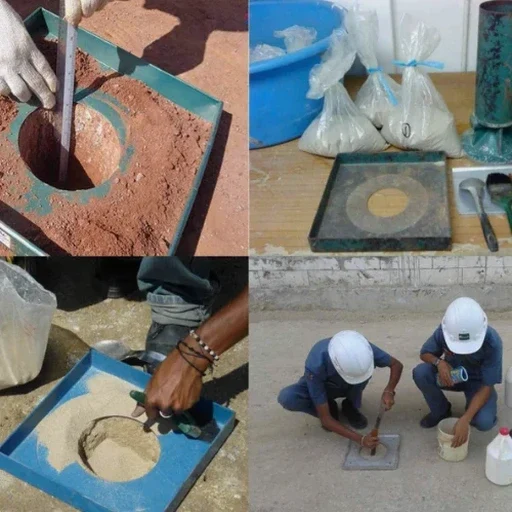
Much of central Swindon sits on the Ancholme Group clays, notorious for their shrink-swell behaviour and sensitivity to moisture change. When the water table rises during wet winters, the effective stress drops and temporary retaining systems can shift more than the design anticipated. Our monitoring arrays capture these nuances with sub-millimetre precision. A typical installation on a Swindon site combines inclinometers behind the retention wall, vibrating wire piezometers to track groundwater pressure, and load cells on tie-back anchors. The data feeds into a cloud dashboard that the site manager and the design team review together, allowing real-time adjustments to the excavation sequence. For projects that require verification of compacted fill beneath haul roads, we also run sand cone density tests to confirm that the platform can handle heavy plant traffic without differential settlement. The result is a feedback loop where the ground truth informs the construction method, rather than the other way around.
Excavation Monitoring in Swindon: Safeguarding Deep Cuts on Variable Ground
Technical reference — Swindon

Local considerations

BS EN 1997-1:2004 mandates the observational method for any excavation where ground behaviour cannot be predicted with full confidence, a description that fits large portions of Swindon's geology. The Kimmeridge Clay formation contains thin limestone bands and fossil-rich layers that create preferential water pathways, complicating dewatering and increasing the risk of base heave. A contractor who proceeds without instrumentation may not detect a progressive failure until it is too late to correct the excavation geometry safely. The financial exposure goes beyond repair costs: a single week of stand-down while an investigation runs can erase the margin on a medium-sized commercial dig. Monitoring provides the evidence trail that insurers and the Health and Safety Executive expect, and in Swindon's mixed ground it is the only way to reconcile the design assumptions with the actual ground response without stopping the works.

Need a geotechnical assessment?

Reply within 24h.

Email: contact@geotechnical-engineering1.com

Reference standards

BS EN 1997-1:2004 (Eurocode 7: Geotechnical design), BS 5930:2015 (Code of practice for ground investigations), CIRIA C760 (Guidance on embedded retaining wall design), BS 8574:2014 (Geotechnical monitoring by field instrumentation)

Reference parameters

ParameterTypical value
Inclinometer range±30° from vertical, 0.01 mm/m resolution
Piezometer typeVibrating wire, 0–1 MPa range typical for Swindon depths
Load cell accuracy±0.5% full scale on tie-back anchors and struts
Crack meter sensitivity0.01 mm, installed on adjacent heritage structures
Data transmission4G cellular logger with 15-minute reading intervals
Reporting standardBS EN 1997-1:2004 Eurocode 7 observational method
Typical monitoring durationFrom bulk dig through to permanent works completion

Questions and answers

What does geotechnical excavation monitoring typically cost for a Swindon basement project?

For a typical residential basement dig in Swindon, a monitoring package including three inclinometers, two piezometers, and weekly reporting over a three-month period usually falls between £650 and £2,220, depending on depth and the number of adjacent structures being tracked.

Is monitoring mandatory under UK building regulations for deep excavations?

While Part A of the Building Regulations does not explicitly name monitoring, compliance with BS EN 1997-1:2004 effectively requires the observational method where ground conditions are variable. Swindon's Building Control team routinely expects a monitoring plan for excavations exceeding 3 metres near public highways or neighbouring foundations.

How quickly are we notified if the ground starts moving beyond the design limit?

Our data loggers transmit readings every fifteen minutes to a cloud platform that compares each value against pre-set trigger levels. If a threshold is breached, the system sends an SMS and email alert to the site manager and the design engineer within two minutes, allowing immediate action before the next excavation stage proceeds.

Can the monitoring system be installed without disrupting the excavation sequence?

Yes. Inclinometer casing is typically installed in boreholes drilled just behind the retaining wall before bulk excavation begins. Piezometers and load cells are placed during the same mobilisation. Once the instruments are in, the excavation continues without interruption and the monitoring team accesses the site only for periodic manual checks and report reviews.

Location and service area

We serve projects in Swindon and surrounding areas.

View larger map